10 Tips for Buying Lithium Ion Battery Cells
Buying lithium ion battery cells is not just a matter of comparing prices or choosing the highest capacity. The right cell must suit its application, operating conditions, and expected service life. Nobel laureate and battery researcher M. Stanley Whittingham helped establish the foundations of modern lithium battery technology. A practical takeaway from his work is simple: chemistry and performance must be considered together.
This guide, “10 Tips for Buying Lithium Ion Battery Cells,” focuses on details buyers can verify. Check the cell’s chemistry, nominal voltage, capacity, dimensions, and discharge rating against your device or system requirements. Look for traceable manufacturer information and clear datasheets. A label alone is not proof. Ask about production dates, storage conditions, testing records, and warranty terms. For a battery pack, confirm that the cells are compatible with its design and battery management system. Small mismatches can cause poor performance, extra heat, or early wear.
Pay attention to practical clues. A capacity figure means little without a stated test method and discharge conditions. Compare like with like. Consider temperature limits, cycle-life claims, and the seller’s return process, too. If documentation is vague, pause and ask questions. That may feel inconvenient. It is still better than discovering a mismatch after installation. No single cell is best for every use, and even a careful checklist cannot replace qualified engineering review for demanding applications.
Define Your Battery Requirements and Intended Application
Before requesting quotes, define what the battery must do in its real setting. A handheld scanner used for six-hour shifts has different needs from a sensor that sleeps most of the day. Write down the device’s operating voltage, normal and peak current, expected runtime, and daily use pattern. Measure the battery compartment, including connector clearance, and note likely temperature, vibration, and moisture exposure. Small details matter. Estimate energy needs from the load and runtime, then allow a practical margin instead of guessing from capacity alone.
Check whether the cell’s discharge rating can support startup surges, not just average current. Confirm its chemistry-specific voltage range and charging limits against the device’s control system and the cell datasheet. If a pack is required, account for its arrangement, protection circuitry, and available space. A higher-capacity option may look attractive, but extra weight or slower recharging can make it unsuitable. A frequent oversight is missing brief current spikes, which can cause resets during use. Test a representative unit under the actual workload and record temperature, runtime, and voltage behavior. Early estimates are imperfect. Revise them after testing, especially if users leave screens, radios, or motors running longer than expected.
Compare Lithium-Ion Chemistries, Cell Formats, and Sizes
Start by matching chemistry to the job, not to a headline capacity number. Lithium iron phosphate cells often trade some energy density for long cycle life and stable behavior. Nickel-rich chemistries can store more energy in less space, but operating limits and thermal management deserve closer review. Check the discharge curve, rated temperature range, and cycle-life test conditions. Numbers need context.
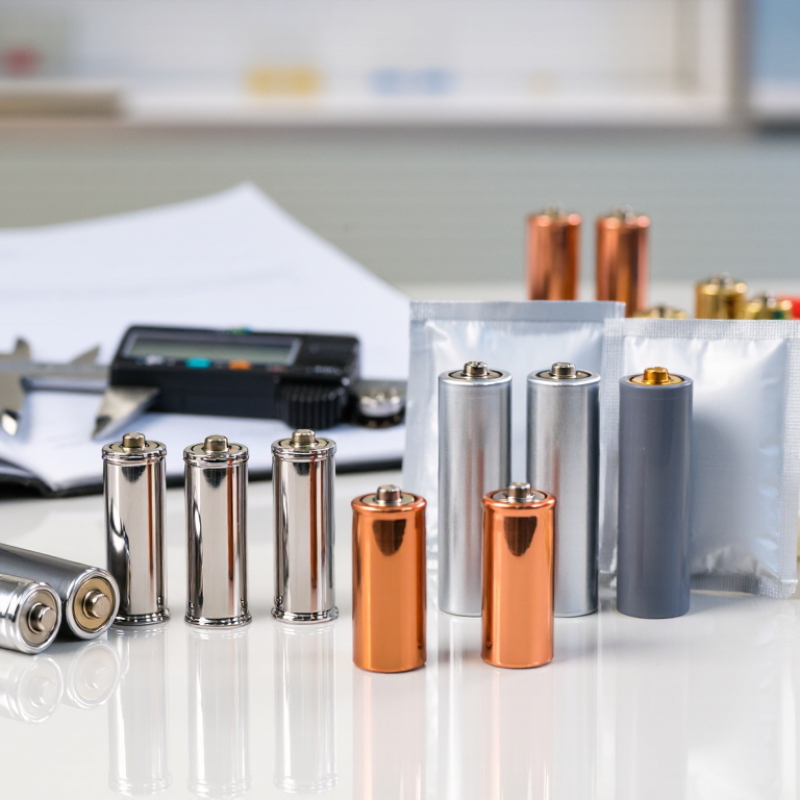
Then compare cell formats. Cylindrical cells are standardized and straightforward to arrange, though many cells may mean more connections. Prismatic cells can simplify module layout, but their dimensions and terminal positions must fit the enclosure. Pouch cells are light and space-efficient; they need suitable compression and protection from edge damage. Measure twice. Cells with similar capacity may still differ in maximum current, internal resistance, or charging voltage.
Size is not just capacity. Record diameter, length, terminal geometry, and space for insulation before choosing a cell. Compare datasheets using the same test conditions, and ask for batch variation and traceability information. Leave room for manufacturing tolerances and, where relevant, cell expansion. A drawing may look right, yet a connector can still clash inside the enclosure. It sounds fussy, perhaps, but one small measurement error can waste a prototype.
Check Capacity, Voltage, Discharge Ratings, and Compatibility
Tip 1: Match capacity and voltage to the device, not just the product listing. Capacity, measured in amp-hours, estimates runtime, but actual output varies with load, temperature, and cutoff voltage. Check the datasheet’s test conditions; two cells rated at 3,000 mAh may provide different usable energy. Confirm the device’s voltage range, too. Small mismatches matter.
Tip 2: Read discharge ratings carefully. Continuous discharge current matters more than a brief peak rating for motors, heaters, and other demanding loads. Compare the expected current with the cell’s continuous rating, and leave some margin. Heat can rise quickly near the cell’s limit. Peak figures are not everyday targets. Check the stated temperature limits.
Tip 3: Check compatibility across the complete battery pack. Cells in series add voltage, while parallel groups affect capacity and current capability. Use cells with matching chemistry, capacity, age, and condition. Pair them with a properly rated battery-management system and charger. Verify dimensions, terminals, and polarity before assembly. Easy to overlook. I’d still recheck the datasheet; labels and remembered specifications can be wrong.
Verify Safety Features, Certifications, and Cell Condition
Before buying lithium-ion cells, match the exact model and chemistry to a verifiable test record. Check whether the cell’s certification covers the model and intended use; a certificate for a similar-looking cell is not enough. For portable cells, ask about IEC 62133-2 testing, and request the UN 38.3 test summary for transport documentation. These are different checks. Neither replaces careful incoming inspection.
Inspect the cells on arrival under good light. Look for dents, torn insulation, corrosion, swelling, or inconsistent labels. Record batch codes, then measure open-circuit voltage with a suitable meter and compare it with the datasheet. Reject unexplained variation rather than trying to “fix” it. Ask whether the cell design includes a pressure vent, current-interrupt device, or other protective features; not every cell uses the same safeguards. The IEA’s Global EV Outlook 2024 reports that EV battery demand exceeded 750 GWh in 2023, up about 40% from 2022. At that scale, traceability matters. I still find paperwork easy to overtrust: certificates show test scope, not the condition of the specific cells in your box.
Evaluate Suppliers, Pricing, Warranty, and Traceability
Buying lithium-ion cells starts with supplier evidence, not a polished catalog. Ask for datasheets tied to the exact cell model and revision. Request recent test reports covering capacity, internal resistance, and cycle conditions. Check whether samples match production cells; a sample can be unusually well selected. Ask who performs incoming inspection and how rejected lots are handled. Clear answers matter. Vague promises do not.
Compare pricing on the same basis: cell grade, quantity, packaging, shipping terms, and test documentation. A low unit price may exclude sorting or traceability records. Ask for a written quote with a validity period and any minimum order quantity. Calculate the cost per usable cell, not merely per delivered cell. For example, if a batch has wider capacity variation, extra screening can erase the apparent savings. The spreadsheet will not catch every risk.
Read warranty terms before ordering. Confirm the coverage period, capacity threshold, storage conditions, and evidence needed for a claim. Ask how claims are assessed and whether replacement or credit is offered. Keep purchase orders, invoices, test results, and batch identifiers together. Traceability should connect each cell to a lot, production date, and inspection record. Verify that labels and documents agree. Small mismatch? Pause and ask. A QR code alone is not proof; records still need to be complete and consistent. This can feel fussy, but battery issues are harder to investigate after cells are installed.