Choosing the best lithium battery cells is not a simple chemistry contest. It depends on energy density, safety, cycle life, temperature, cost, and application demands. A city electric vehicle may need compact power and fast charging. A home storage system may value long service life and stable operation more.
Industry data shows why this decision matters. The International Energy Agency’s Global EV Outlook 2024 reported that lithium iron phosphate, or LFP, approached 40% of the global electric vehicle battery market in 2023. LFP cells generally offer strong thermal stability, lower material costs, and long cycle life. Nickel manganese cobalt, or NMC, usually provides higher energy density. That advantage can reduce vehicle weight, but it may increase cost and thermal-management requirements. Neither chemistry wins everywhere.
Price trends add another layer. BloombergNEF’s 2024 Battery Price Survey reported an average battery-pack price of $115 per kilowatt-hour, a 20% annual decline. However, pack prices are not cell prices. The distinction matters when comparing quotations from suppliers. Cell shape matters too. Cylindrical cells are mechanically consistent and highly automated. Prismatic cells use space efficiently. Pouch cells can be lightweight, but their swelling control requires careful engineering.
This guide examines these choices through practical evidence, not marketing claims. It compares lithium battery cells by chemistry, form factor, operating conditions, and total ownership cost. There is no universal winner. That answer sounds neat, but it is incomplete. Real installations sometimes expose weaknesses that laboratory rankings miss.
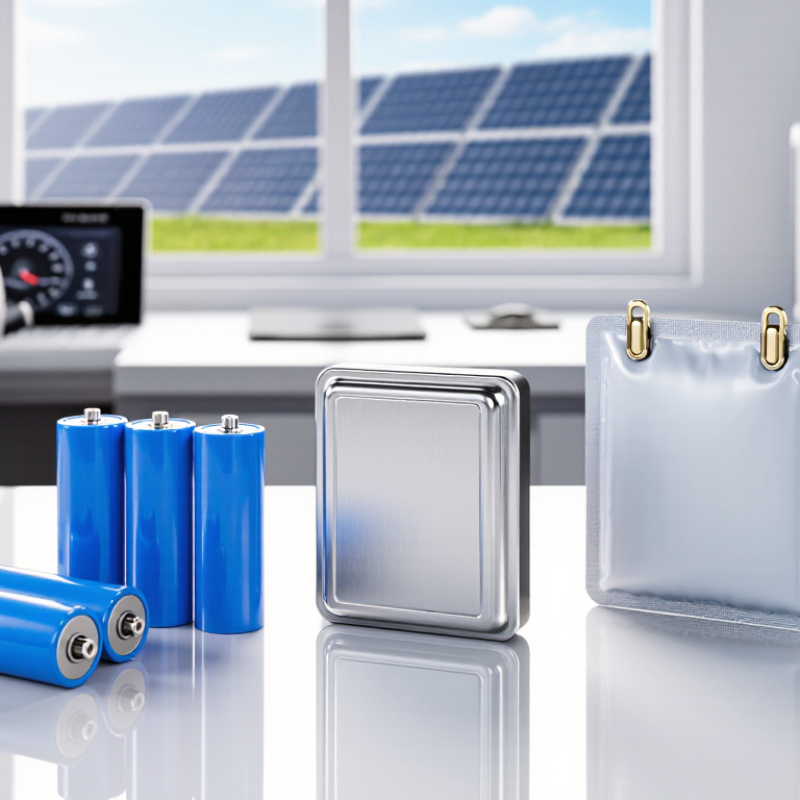
There is no universal winner among lithium battery chemistries. Each cell balances energy density, safety, cost, charging speed, and service life. LFP cells offer strong thermal stability and long cycle life. Their energy density is usually lower than NMC and NCA cells. The International Energy Agency reported that LFP reached about 40% of the global electric vehicle battery market in 2023. That shift reflects cost and durability, not just performance.
NMC cells provide a practical balance between range and power. NCA cells can deliver high energy density, but they require careful thermal management. LTO cells accept rapid charging and can survive many more cycles. Their low energy density makes the pack heavier and larger. According to the U.S. Department of Energy, lithium battery evaluation commonly tracks energy density, power density, cycle life, and efficiency. Those metrics matter more than chemistry names alone.
Cost also changes the decision. BloombergNEF reported an average lithium-ion battery pack price of 139 dollars per kilowatt-hour in 2023. Cell prices differ by region, format, and contract volume. Real-world results can fall below laboratory figures. Cold weather reduces available power. High charging rates increase heat. A careful buyer should compare usable capacity, warranty conditions, cooling design, and measured cycle data. Marketing numbers are useful, but incomplete.
What Is the Best Type of Lithium Battery Cells?
Energy Density: NMC/NCA 200–280 Wh/kg Versus LFP 120–180 Wh/kg
Cell chemistry determines how much energy fits into each kilogram. NMC and NCA cells commonly reach 200–280 Wh/kg. LFP cells usually provide about 120–180 Wh/kg. These figures are practical industry ranges, not guarantees for every cell. Technical reviews from the International Energy Agency’s Global EV Outlook 2024 and the U.S. Department of Energy’s Vehicle Technologies Office connect energy density with chemistry, electrode design, and manufacturing quality.
At the same usable energy, a 150 Wh/kg LFP cell needs more mass than a 240 Wh/kg NMC cell. That difference affects payload, driving range, and available cabin space. However, cell figures are not pack figures. Cooling plates, wiring, enclosures, and safety margins reduce system-level density. The difference becomes visible in real vehicles. A lighter cell is not automatically a lighter battery pack.
LFP has limits.
LFP chemistry generally offers strong cycle durability, stable thermal behavior, and lower dependence on expensive materials. The IEA reported rising LFP adoption as manufacturers sought lower costs and broader material availability. NMC and NCA remain attractive when long range and low weight matter most. Still, a 250 Wh/kg specification can disappoint in cold weather or poor pack integration. I would not choose chemistry from one number alone. Real operating data deserves more attention.
NMC and NCA cells generally provide higher gravimetric energy density, typically around 200–280 Wh/kg. LFP cells commonly deliver about 120–180 Wh/kg, offering lower energy density but often stronger thermal stability and longer cycle-life potential. Actual performance varies by cell design, pack configuration, and operating conditions.
Choosing lithium battery cells depends on safety, lifespan, weight, and power demand. LFP cells typically deliver 2,000–5,000 cycles under suitable operating conditions. Their stable chemistry also reduces thermal risk during normal use. They are a practical choice for home storage, backup systems, and daily-use vehicles. However, LFP cells are often heavier and less energy-dense than NMC cells.
NMC cells commonly provide about 1,000–2,000 cycles. They store more energy in a smaller and lighter package. This advantage can matter in portable equipment or applications with strict space limits. Yet higher energy density requires careful temperature control and battery management. Real cycle life changes with charging speed, discharge depth, heat, and storage voltage. Published figures are useful, but they are not promises. I have seen poorly cooled packs age faster than expected, even when their specifications looked impressive.
Tips: Keep the battery cool, avoid constant full charging, and use a reliable battery management system. Check manufacturer test conditions before comparing cycle figures. A 5,000-cycle rating may assume gentle use, moderate temperatures, and controlled charging. That detail is easy to miss. In practice, the best cell is not always the one with the longest claimed life. It should match the application, available space, safety requirements, and maintenance habits. Reconsider the choice if weight becomes a daily burden.
When asking, “What Is the Best Type of Lithium Battery Cells?” the answer depends on the application. Lithium titanate oxide, or LTO, deserves attention where power and charging speed matter most. These cells can accept high charging currents and deliver strong output during sudden acceleration, lifting, or industrial load changes. In suitable systems, LTO packs can exceed 10,000 cycles before capacity falls significantly.
That durability comes from stable electrode chemistry and excellent resistance to heat-related stress. A well-designed LTO battery may recharge during short pauses, such as a delivery vehicle stopping for loading. This reduces waiting time and can support continuous daily operation. However, charging speed still depends on the charger, wiring, battery management system, and temperature. Fast charging is never just a cell feature.
The main weakness is lower energy density. An LTO pack usually needs more space and weight than a comparable high-energy lithium pack. It may also cost more initially. That trade-off is easy to underestimate. In practical testing, poor thermal control or aggressive charging can still shorten service life. Engineers should examine cycle data under real load profiles, not only laboratory ratings. For equipment operating many times each day, replacing energy density with exceptional cycle life may be a sensible choice. For lightweight applications, it may not be.
What Is the Best Type of Lithium Battery Cells?
Choosing the best lithium battery cell starts with chemistry, not marketing. Lithium iron phosphate cells offer strong thermal stability, long cycle life, and lower material costs. The International Energy Agency reported that LFP cells represented about 40% of the global electric vehicle battery market in 2023. They usually suit energy storage, commercial vehicles, and systems needing frequent daily cycling.
Nickel-rich chemistries provide higher energy density. That matters when a battery must fit inside a small enclosure or support longer driving ranges. However, they demand tighter thermal control and careful charging limits. BloombergNEF reported an average battery pack price of 139 dollars per kilowatt-hour in 2023, down 14% from the previous year. Lower prices help, but installation, cooling, safety controls, and replacement costs still shape the real budget.
Temperature can quietly change the decision. Cold conditions reduce available power, while sustained heat accelerates aging. A cell rated for excellent performance at 25°C may behave differently inside a poorly ventilated cabinet. Check capacity retention, discharge limits, cycle testing, and warranty assumptions under realistic temperatures. Do not compare energy density alone. It is an incomplete shortcut. I would not call any chemistry perfect; even LFP can lose practical capacity in cold weather, and higher-density cells may justify their complexity in space-limited equipment. Reliable selection requires matching chemistry, cost, temperature, and application.
| Cell Chemistry | Typical Nominal Voltage | Typical Specific Energy | Cycle Life Range* | Thermal Stability | Power Capability | Low-Temperature Performance | Relative Cost | Main Advantages | Main Limitations | Best-Fit Applications |
|---|---|---|---|---|---|---|---|---|---|---|
| Lithium Iron Phosphate (LFP / LiFePO4) |
3.2 V | 90–160 Wh/kg | 2,000–6,000 cycles | Excellent; strong resistance to thermal runaway compared with high-nickel chemistries | High; suitable for many high-current designs | Reduced capacity and power below 0°C; charging below 0°C requires careful control or heating | $$ | Long service life, good safety margin, stable voltage, widely available raw materials | Lower energy density; larger and heavier pack for the same stored energy | Stationary storage, solar systems, backup power, commercial vehicles, recreational vehicles |
| Nickel Manganese Cobalt Oxide (NMC / LiNiMnCoO2) |
3.6–3.7 V | 150–250 Wh/kg | 1,000–2,500 cycles | Good with a properly designed battery-management and thermal-control system | High; energy and power can be balanced through cell formulation | Generally better than LFP at moderate cold temperatures, but capacity still decreases below 0°C | $$$ | High energy density, flexible performance, good balance of power and capacity | More sensitive to overcharge, heat, and mechanical abuse than LFP; cobalt and nickel add cost and supply considerations | Passenger electric vehicles, e-bikes, power tools, compact energy-storage systems |
| Nickel Cobalt Aluminum Oxide (NCA / LiNiCoAlO2) |
3.6–3.7 V | 180–260 Wh/kg | 1,000–2,000 cycles | Moderate; requires effective monitoring, cooling, and charge protection | High; optimized for high energy and strong power output | Capacity and charging performance decline in cold conditions; preheating may be needed | $$$ | Very high energy density and relatively low cell weight | Higher thermal-management requirements and lower abuse tolerance than LFP | Long-range electric vehicles, aerospace equipment, high-performance portable systems |
| Lithium Cobalt Oxide (LCO / LiCoO2) |
3.6–3.7 V | 150–240 Wh/kg | 500–1,000 cycles | Moderate to limited; strict voltage, temperature, and protection controls are important | Moderate; generally not preferred for repeated high-current use | Acceptable in controlled consumer-electronics conditions; performance falls at low temperature | $$$ | High energy density, mature design, compact form factor | Shorter cycle life, higher cost exposure to cobalt, and relatively lower thermal stability | Phones, cameras, laptops, and other compact consumer electronics |
| Lithium Manganese Oxide (LMO / LiMn2O4) |
3.7–4.0 V | 90–150 Wh/kg | 500–1,500 cycles | Good; generally safer than LCO and some high-nickel formulations | Very high; supports strong short-duration power output | Moderate; usable with appropriate thermal management but capacity declines in cold conditions | $$ | High power capability, relatively low material cost, good thermal behavior | Lower energy density and faster capacity fade than LFP or many NMC cells | Medical equipment, power tools, hybrid vehicles, high-power devices |
| Lithium Titanate (LTO / Li4Ti5O12) |
2.3–2.4 V | 50–90 Wh/kg | 10,000–25,000 cycles | Excellent; strong resistance to lithium plating and thermal stress | Exceptional; supports very high charge and discharge rates | Excellent relative to most lithium-ion chemistries; can operate and charge at lower temperatures with suitable controls | $$$$ | Extremely long cycle life, rapid charging, high power, excellent low-temperature behavior | Very low energy density, higher pack cost, and more cells required for a given voltage | Fast-charge buses, industrial equipment, grid power services, high-cycle applications |