
51.2V100AH 5120WH
Model Litio 5000
Battery Type Life PO4 (LEP)
Nominal Voltage (V) 51.2 V
Nominal Capacity(WH) 5120WH
Usable Capacity(WH) 4096WH/80%DOD
Design Life 10+Years (25 / 77F)
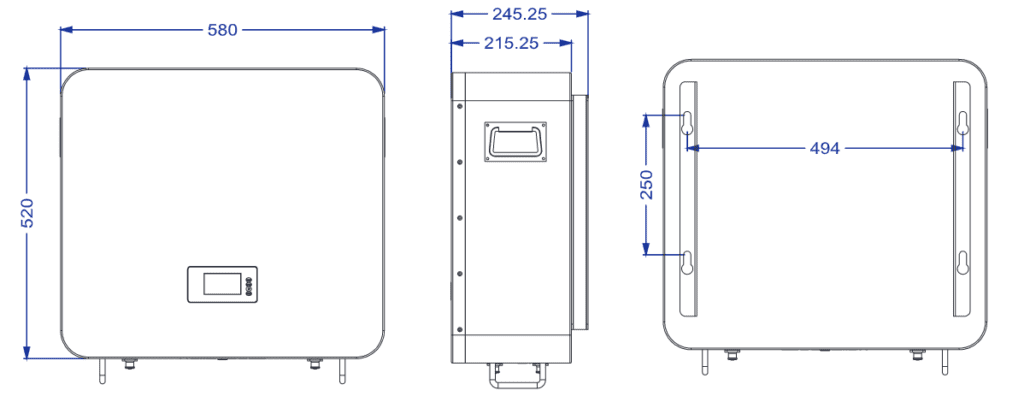
Dimension (mm) 520*580*215.25
Weight(kg) 60
Operating Temperature Range -10 ~ 50
Transport or Storage Temperature Range -20 ~ 45
Humidity 15% ~ 85% (No Condensing)

Cycle Life >4500, 25c
Discharge Voltage(V) 40 ~ 58.4
Charge Voltage (V) 56 ~ 58.4
Charge/Discharge Current (A) 50A(Recommended)
100A (Max)
Usable Capacity(WH) 4096WH/80%DOD
Internal Resistance <= 30m(ohm)
Power Consumption <2W (Work) < 100mW Sleep
Monitoring Parameters System voltage, Current,
cell Voltage, Cell
Temperature, module
temperature
SOC Intelligent Algorithm
Communication CAN / RS-485/ RS-232


Power Switch: To turn ON / OFF the whole battery BMS standby, power output ready.
SOC Light: Green LEDs flashing to show the battery is running.
RUN Light: Green LED flashing to show the battery is running.
Alarm Light: Red LED flashing to show the battery has alarm, and lighting to show the battery is under protection.
State | Norminal / Warning / Instruction | RUN | ALM | Power Indicator LED | Instruction |
|---|---|---|---|---|---|
Shut Down | Dormancy | OFF | OFF | OFF | OFF | OFF | OFF | Instruction | |||
|---|---|---|---|---|---|---|---|---|---|---|---|
Standby | Norminal | Flash 1 | OFF | Follow module capacity | Standby | ||||||
Warning | Flash 1 | Flash 3 | Module at Low Volatge | ||||||||
Charge | Norminal | ON | OFF | Follow module capacity ( Flash 2 at full capacity) | LED Flash 2 at full capacity , ALM doesn’t flash at overcharge warning | ||||||
Warning | ON | Flash 3 | |||||||||
Over Charge Protection | ON | OFF | ON | ON | ON | ON | If no grid supply, LED turn to standby. | ||||
Temperature, over current, disabled protection | OFF | ON | OFF | OFF | OFF | OFF | Stop Charging | ||||
Discharge | Norminal | Flash 3 | OFF | Follow module capacity | |||||||
Warning | Flash 3 | Flash 3 | |||||||||
Under Voltage Protection | OFF | OFF | OFF | OFF | OFF | OFF | Stop Discharging | ||||
Temperature, over current, short circuit, reverse connect, disabled protection | OFF | OFF | OFF | OFF | OFF | OFF | Stop Discharging | ||||
Disabled | OFF | OFF | OFF | OFF | OFF | OFF | Stop charging & discharge | ||||
Note: The flashing instructions, flash 1 – light 0.25s / off 3.75 seconds; flash 2-0.5 light / 0.5s off; flash 3-0.5s light / 1.5s off | |||||||||||
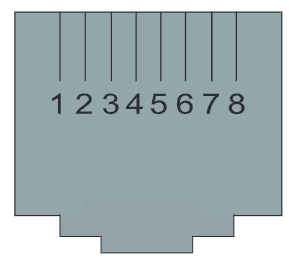
NO | RJ 45 PIN |
|---|---|
1,8 | RS485-B |
2,7 | RS485-A |
3,6 | GND |
4 | CAN-H |
5 | CAN-L |
Protection and Alarm | Management and Monitor |
|---|---|
Charge / Discharge | Cells / Balance |
Charge Over Voltage | Intelligent Charge Model |
Charge / Discharge Over Current | Charge / Discharge Current Limit |
High / Low Temperature | Capacity Retention Calculate |
Short Circuit | Administrator Monitor |
Power Cable Reverse | Operation Record |

Two long cables ( current capacity 120A ) and one communication cable for each energy storage system
Note: If the customer needs cabinet, please contact our salers.
Double-check all the power cables & communication cables.
Switch on all the battery modules and the green LED light below will be on;
Set ADD follow ADD INSTRUCTION, pack 1 will be host, others are salves.
(1) Whether the battery can be turned on.
(2) If battery is turned on, check the red light is off, flashing or lighting:
(3) If the red light is off, check whether the battery can be charged/discharged.
1) Battery cannot be turned on, switch on the lights are all no lighting or flashing. If the battery external switch is ON, the RUN light is flashing, and the external power supply voltage is 51.2V or more, the battery still unable to turn on, please contact distributor.
2) The battery can be turned on, but red light is lighting, and cannot be charged or discharged, red light is lighting, that means system is abnormal, please check values as following:
3) Temperature: Above 50 or under -10, the battery could not work.
Solution: to move battery to the normal operating temperature range between -10 & 50.
4) Current: If current is larger than 100A, battery protection will turn on.
Solution: Check whether current is too large or not, if it is, to change the settings on power supply side.
5) High Voltage: If charging voltage above 58.4V, battery protection will turn on.
Solution: Check whether voltage is too high or not, if it is, to change the settings on power supply side.
6) Low Voltage: When the battery discharges to 40V or less, battery protection will turn on. Solution: Charge the battery for some time, the red light will turn off. Excluding the four points above, if the faulty is still cannot be located, turn off battery and repair.
(1) Cannot be charged: Disconnect the power cables, measure voltage on power side, if the voltage is 56.5~57.6V,restart the battery, connect the power cable and try again, if still not work, turn off battery and contact distributor.
(2) Unable to discharge: Disconnect the power cables and measure voltage on battery side, if it is under 40V, please charge the battery; if voltage is above 51.2V and still cannot discharge, turn off battery.